Local SEO in Wiltshire: A Practical Guide for Trades
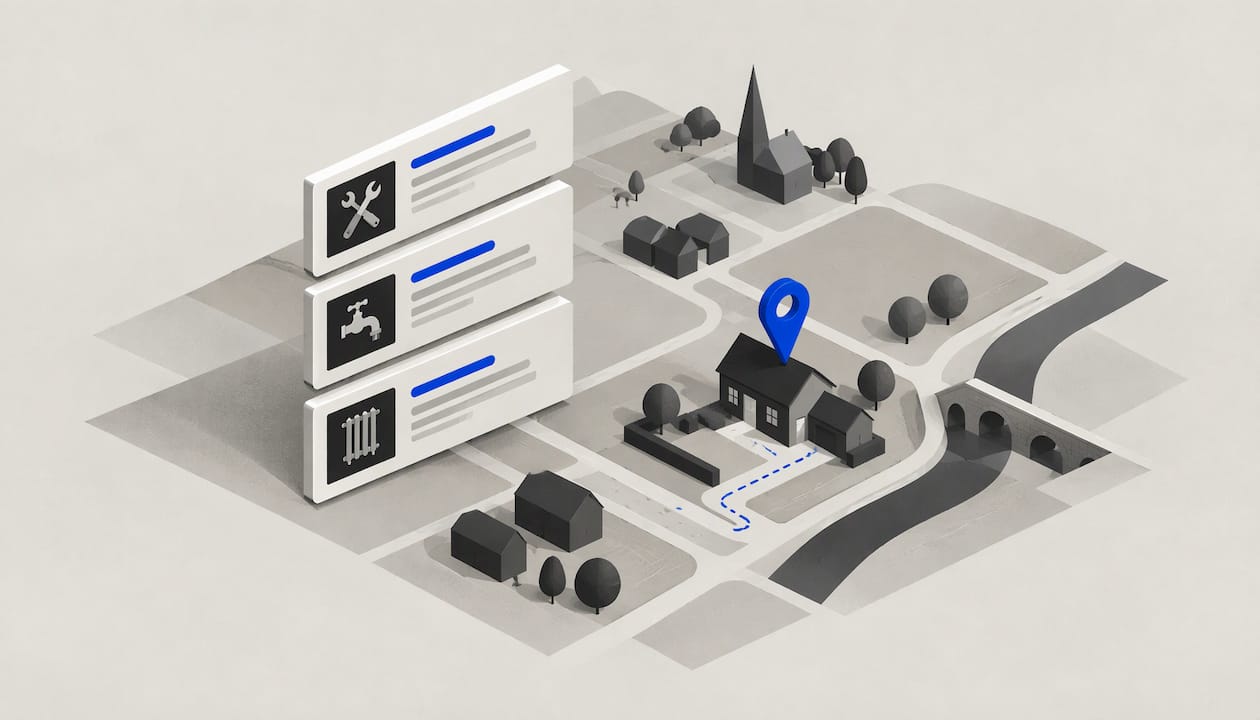
Local SEO for a Wiltshire trade comes down to three things working together: a complete, verified Google Business Profile, a website with a page for each service and each area you cover, and a steady flow of genuine reviews. Get those right and Google has clear reasons to show you when someone in Corsham, Chippenham or Melksham searches for an electrician, roofer or plasterer. We build and manage exactly this for UK trades, so this guide sets out the routine in the order we would do it, and where each step usually goes wrong.
TL;DR
- Google decides local rankings mainly on relevance, distance and popularity, and you cannot pay Google for a better local position.
- Start with a verified Google Business Profile with accurate address or service area, hours, phone number and the fewest categories that describe your core trade.
- Give every main service its own page on your website, and mention the Wiltshire towns you really work in, naturally and in plain English.
- Track calls, website clicks and direction requests in your Business Profile performance report rather than guessing.
- Local SEO builds over weeks and months, and no one can honestly promise a position or a number of enquiries.
Table of Contents
- What local SEO means for a Wiltshire trade
- Step 1: Get your Google Business Profile right
- Step 2: Build a website that answers local searches
- Step 3: Reviews and consistent details
- Step 4: Measure calls, not just rankings
- How long does it take?
- A sensible order of work
- Our view
- What we offer Wiltshire trades
- FAQ
- Sources
What local SEO means for a Wiltshire trade
Local SEO is the work of making your business appear when someone nearby searches for what you do. For a trade, that usually means two places on the results page: the map pack (the three or so businesses shown with a map above the ordinary results) and the standard listings underneath.
Google explains that local results are mainly based on relevance, distance and popularity. Relevance is how well your profile and website match the search. Distance is how far you are from the person searching, or from the place named in the search. Popularity is how well known you are, which reviews, links and mentions feed into.
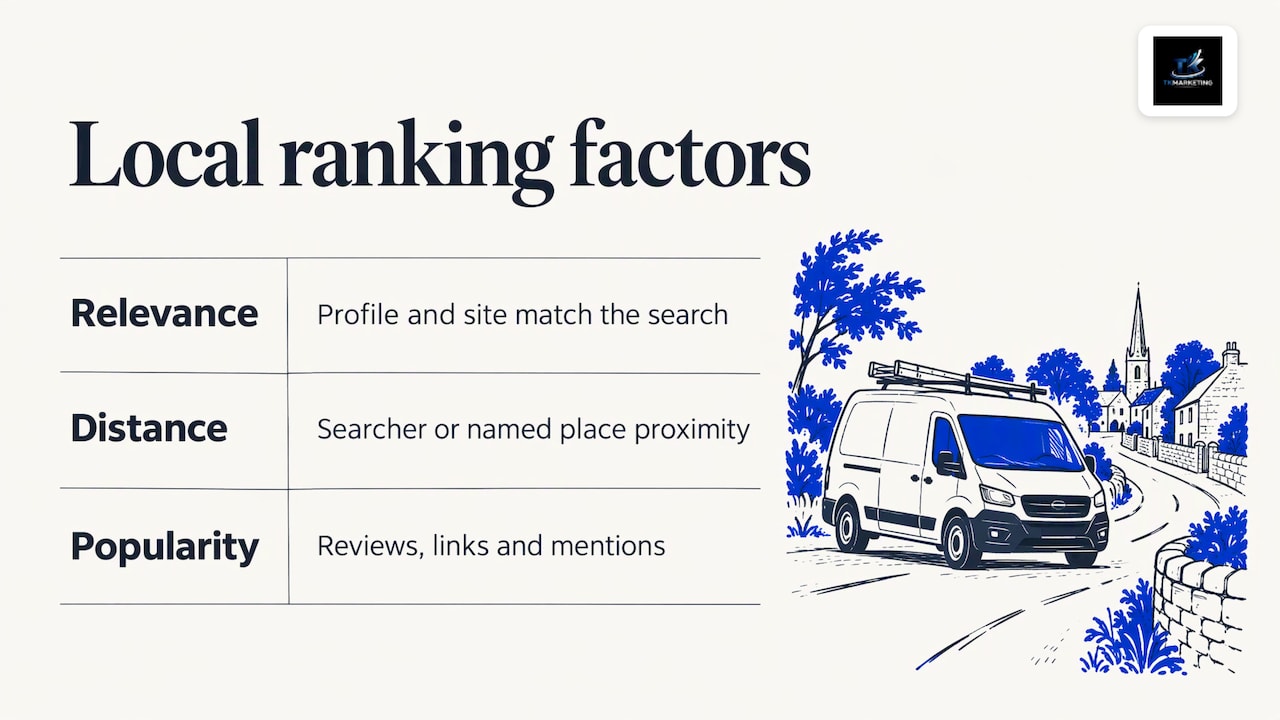
That has a practical meaning in Wiltshire. A plumber in Corsham is physically close to people searching in Corsham, and you cannot change that. What you can change is how clearly your profile and website say what you do, and how much evidence there is that real customers rate you. Google also states that businesses cannot request or pay for a better local ranking, so be wary of anyone who sells a place in the map pack as a fixed product.
The search results for this topic are full of agencies in Salisbury, Swindon, Devizes and further afield. Most describe the service in general terms. A tradesperson needs something narrower: what to do this month, in what order, and how to tell whether it is working.
Step 1: Get your Google Business Profile right
The profile is the free listing that appears on Google Search and Maps. Google says it is available to eligible storefront and in-person service businesses, which includes most trades. For a local business with a small website, it is usually the single biggest lever, so it comes first.
Verify and complete it
Google recommends verifying the business and keeping its information complete and accurate: address, opening hours, category and details. Verification matters beyond ranking. Performance data is only available for verified profiles, so an unverified profile leaves you blind as well as less visible. We cover the order of work in more detail in our guide to Google Business Profile for contractors.
Name, categories and one profile
Google’s guidelines say to use your real-world business name, an accurate address or service area, and the fewest categories needed to describe the core business, with one profile per business. In practice, the common mistakes are:
- Adding keywords to the business name, such as “Smith Plumbing Corsham Best Plumber”. It breaks the guidelines and risks suspension.
- Choosing ten categories. Pick the one that describes your main trade as the primary category and add only what genuinely applies.
- Creating a second profile for a second town you do not have premises in.
Home-based trades: hide the address, set a service area
Most trades work from a van and a home address. Google’s guidelines say service-area businesses that do not receive customers at their address should hide that address and use an accurate service area. Virtual offices are not eligible unless staffed during opening hours, so a rented mailbox in Bath will not help a Corsham builder.
Google’s editing documentation says a service area can be defined using cities, postcodes or other places served. List the places you genuinely cover: Corsham, Box, Lacock, Chippenham, Melksham, Bradford on Avon and so on. Do not list the whole county in the hope of covering it. A realistic radius around where you are based fits how Google weighs distance.
Write the description properly
The description is limited to 750 characters and should focus on what you offer and what makes you distinctive. Say what you do, where, and one concrete detail: the types of job, how quickly you quote, the accreditations you hold. Skip promotional wording and phone numbers.
Photos and videos
Photos of real finished jobs, your van and your team show a customer who is about to let you into their home what to expect. We go through what to upload in our guide to Google Business Profile photos. If you want to see how different Google Business Profile management software handles images and video, that overview compares the options.
For a quick routine, our five quick actions for UK trades is a good place to start.
Step 2: Build a website that answers local searches
Your profile gets you into the map pack. Your website is what convinces a visitor, and it gives Google more evidence of what you do and where.
One page per service
A single “Services” page that lists everything in one paragraph rarely ranks for anything. A better structure is a separate page for each main job: boiler replacement, rewiring, flat roofs, driveways. Each page should include:
- A plain heading naming the service and the area, for example “Boiler servicing in Corsham”.
- What the job involves, typical stages and what the customer needs to provide.
- Examples of real work, with photos where you have permission.
- Your phone number, visible without scrolling, and a short enquiry form.
- Accreditations or insurance you actually hold.
Our guide to service page SEO explains how to build pages like these so they can be found.
Mention places, but only the real ones
If you work across north Wiltshire, say so, and name the towns where you have done jobs. A short paragraph on a completed job in Box or Lacock reads naturally and tells both customers and Google where you operate. Avoid creating dozens of near-identical “plumber in [town]” pages with only the place name swapped. They read as padding to customers, and they dilute the pages that matter.
Make the phone the goal
Most trade enquiries are calls. Put a tap-to-call number at the top of every page on mobile, keep forms short, and make sure the page loads quickly on a phone. If you miss a call while you are up a ladder, a prompt reply can keep the job: that is what our TK Text Back missed-call texts are for.
Keep it current
A site that has not been touched for two years tells visitors little about whether you are still trading. Updated service details, recent project photos and working contact information matter, and so does the technical side: hosting, security and speed. That ongoing upkeep is the reason we offer monthly management alongside the build.
Step 3: Reviews and consistent details
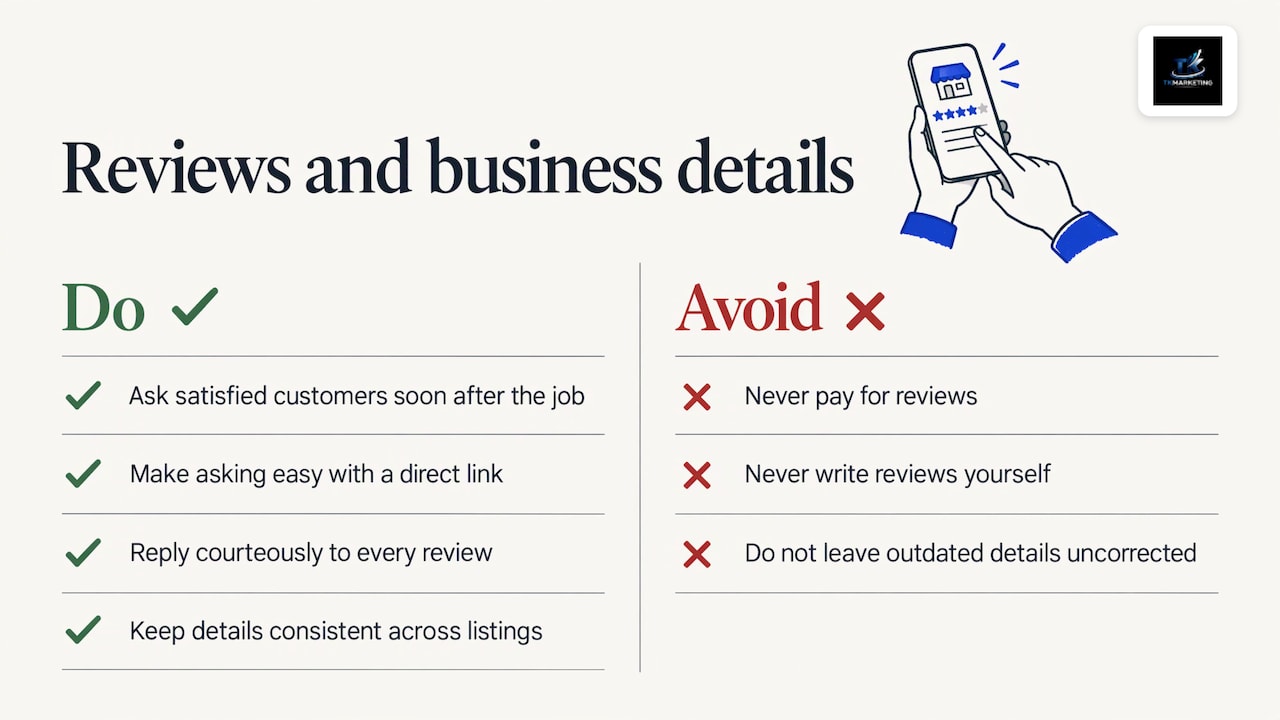
Popularity in Google’s terms includes how well known and well regarded you are, and reviews are the most visible part of it for a trade. Ask every satisfied customer, soon after the job is finished while they remember it, and make it easy with a direct link to your review form. Reply to each review in a courteous, specific way, including the occasional poor one. Never offer payment for reviews or write them yourself. Our guide on getting more Google reviews covers the wording and timing.
Consistency matters as well. Your business name, phone number and area should read the same on your website, profile, social pages and any directories you appear in. If you have changed number or moved house, correct every listing you can find, because mismatched details confuse customers as well as search engines.
A periodic check helps. Every few months, search for your own business name, your trade plus your town, and your phone number, and note anything wrong or out of date. Our 90-day Google Business Profile audit sets out what to look at, including the points trades often miss around claims made in listings.
Step 4: Measure calls, not just rankings
Rankings move depending on who is searching and from where, so a screenshot of position three on your own phone proves little. Measure what the business wants: calls and enquiries.
For a verified profile, Google’s performance report shows calls from the call button, website clicks, direction requests, views and the search terms people used. The search terms update at the start of each month and can take up to five days to appear, so check in the first week of the month rather than daily.
Google also said in its June 2026 small business bulletin that Business Profile would soon link to Google Analytics, bringing calls, bookings, direction requests and website clicks alongside website data. Use whatever view is available to you and keep a simple monthly record:
| Month | Profile calls | Website clicks | Direction requests | Enquiries by form | Jobs won |
|---|---|---|---|---|---|
| Example | Your figure | Your figure | Your figure | Your figure | Your figure |
Also ask each new customer how they found you and write it down. Customers often search, view the profile, then call from the website, and your own record fills the gaps the reports leave.
How long does it take?
Set expectations honestly. A profile that is verified and completed can start to appear for relevant searches quite soon, but climbing above established competitors in a busy town takes longer, and reviews accumulate one job at a time. Nobody can promise a particular position or number of enquiries, and Google itself says local rankings cannot be bought. What you can control is the quality and consistency of the work: a complete profile, clear service pages, regular reviews and prompt replies to enquiries.
In a smaller place such as Corsham, fewer businesses compete for each search, which can help a well-prepared profile and site. In Swindon or Salisbury, expect to put in more over a longer period.
A sensible order of work
- Claim and verify your Google Business Profile, then complete every field.
- Set your service area to places you genuinely cover and hide your home address if customers do not visit you.
- Make sure your website has a page for each main service, with your phone number prominent.
- Add real photos of recent jobs to both profile and site.
- Start asking for a review after every job.
- Check your performance report monthly and record calls and enquiries.
- Audit your details every quarter.
Our local SEO checklist for UK trades and contractors puts the whole routine in one list.
Our view
Most of the trades we speak to are not short of skill. They are short of time. The work above is not complicated, but it never ends: reviews need replying to, photos need adding, the website needs keeping fresh, and the phone needs answering.
That is why we built our service around being hands-off for the owner. We build trade websites in 10 to 14 days, with written content supplied and SEO built in, then manage them monthly with updates, hosting and security checks. We also audit and manage Google Business Profiles, and we match the brand on your site to your van, signage and print so customers see the same business everywhere.
We do not promise rankings, because nobody honestly can. We do aim to make sure that when a Wiltshire customer finds you, the profile and the website both look like a business worth ringing.
Trey
What we offer Wiltshire trades
If you would rather spend your evenings on quotes than on website updates, our trade websites are designed to bring enquiries to the phone. Our published plans are Shopfront at £39 per month with a £299 one-off setup, Shopfront Plus at £59 per month with a £399 setup, and Website Max at £499 per month with a £599 setup. You can also have a WordPress website for a one-off £599, or an AI-assisted framework website at £35 per month or £350 per year. You can see the options on our web design page and the plans on our pricing page.
For your Google profile, our Google Business Profile service includes monthly management from £20 per month. Start with whichever matches where you are: a new site, a tidier profile, or both together.
FAQ
Is local SEO worth it for a small trade business in Wiltshire?
For a business that depends on local customers finding it, it is a sensible use of time, because it focuses on people already searching for your trade nearby. The core steps cost little beyond your time: a verified profile, clear service pages and regular reviews. Results build gradually and cannot be guaranteed.
Can I pay Google to rank higher in the map results?
No. Google states that businesses cannot request or pay for a better local ranking, which is based mainly on relevance, distance and popularity. Paid adverts are separate and appear marked as such.
Should I list my home address on my Business Profile?
If customers do not visit you there, Google’s guidelines say to hide the address and set a service area instead. Choose the towns and postcodes you genuinely cover, such as Corsham and the villages around it, rather than the whole county.
How do I know if local SEO is working?
Check your verified profile’s performance report once a month for calls, website clicks, direction requests and search terms. Add your own record of enquiries and of how each new customer found you, then compare month by month.
Sources
- Tips to improve your local ranking on Google
- Guidelines for representing your business on Google
- Edit your Business Profile
- Get started with Google Business Profile
- Understand your Business Profile performance and insights
- Google Small Business Bulletin, June 2026